2010 Hottest Year on Record: The Graph That Should Be on the Front Page of Every Newspaper

By Peter H. Gleick
HUFFINGTON POST

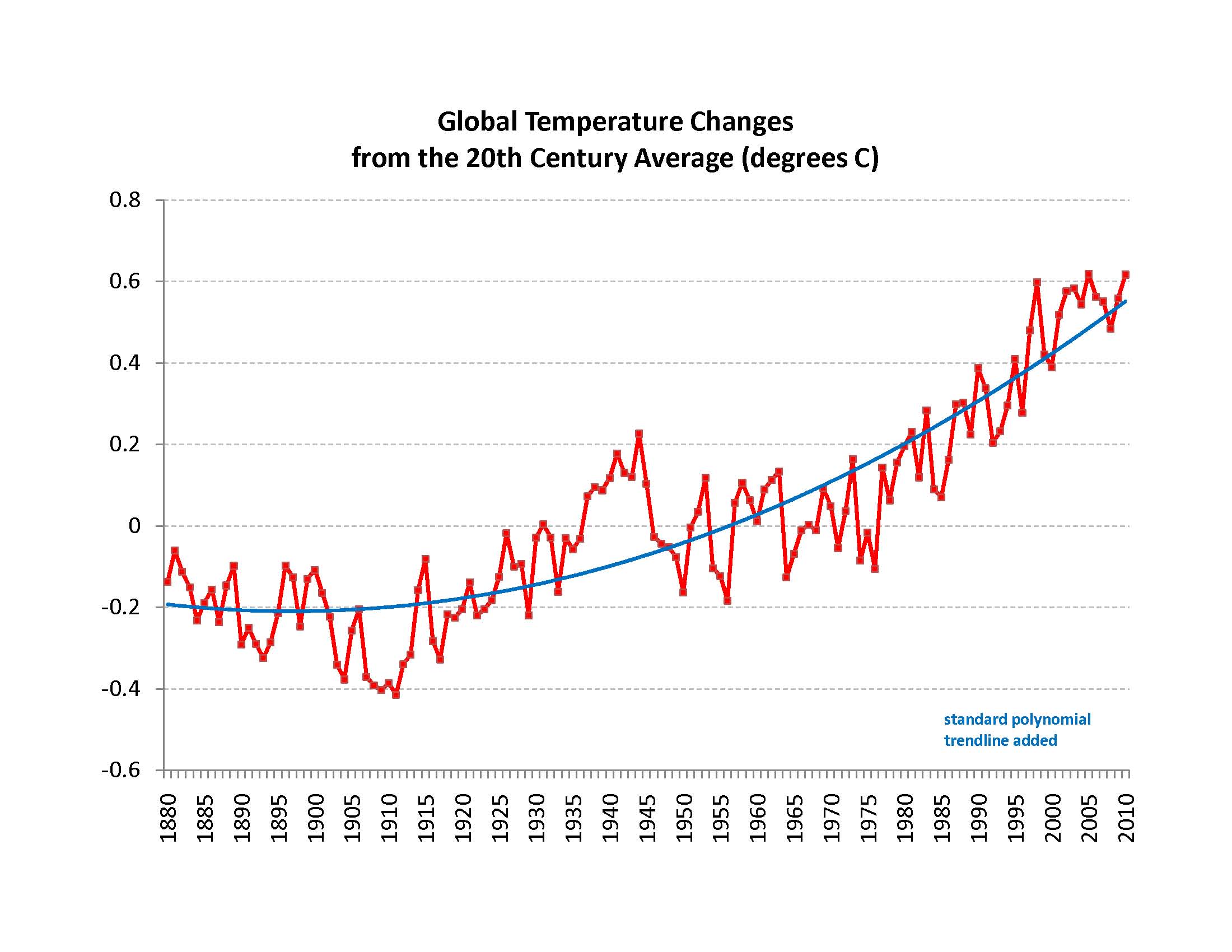
Climate change is worsening, fast. The National Climate Data Center of the National Oceanic and Atmospheric Administration has just announced that for the entire planet, 2010 is the hottest year on record, tied with 2005. And the period 2001 to 2010 is the hottest decade on record for the globe. The actual data are here.

This graph and this information should be on the front page of every newspaper in the world. Every Congressional representative should see it.

2011-01-14-GlobalTemperatures2.xls.jpg

And the hottest 10 years on record in order?
2010
2005
1998
2003
2002
2009
2006
2007
2004
2001

How often do you have to get hit on the head before you say “ouch.” Or before you even say “stop hitting me on the head”? For climate deniers, probably forever. We can expect them to talk about how cold the winter is, here or there.But for the rest of us, enough should be enough. The planet has a fever and it’s getting worse.

Posted in CAPITALISM, ENVIRONMENT, GLOBALIZATION, POLICY, RESOURCES | Leave a comment

Map of the recent mass animal deaths

Posted by Nick Eaton
SFGate


I didn’t realize just how many bizarre cases of mass animal deaths have occurred in the past month, until I saw the custom Google Map shown above.

Birds and fish have been dying en masse left and right, prompting many people to start talking about conspiracy theories or the apocalypse. Scientists, meanwhile, have been telling the public these die-offs aren’t rare.

But jeez – how common is this?

In the map above, most of the incidents are dead fish. Birds also seem quite unlucky.

The great thing about the Google Map is that each location is accompanied by a news story about the incident. Want to learn about the estimated 100,000 dead drum fish – yes, one-hundred thousand -that clogged 20 miles of an Arkansas river three days ago? Check the report here. Didn’t hear about how summer weather is killing off penguins in New Zealand? Link and learn.

Check out the custom Google Map HERE.

Posted in CAPITALISM, ENVIRONMENT, GLOBALIZATION, RESOURCES | Leave a comment

SOLUTIONS: High Pay Commission

In an effort to try and curb hefty bonuses, and perhaps risky behavior, in the financial sector, a group of labor unionists, journalists and academics from the U.K. have launched a high pay commission.

Posted in CAPITALISM, DEMOCRACY, INTERNATIONAL, POLICY, RESOURCES, SOLUTIONS | Leave a comment

Cyberwar

Posted in CAPITALISM, POLICY, RESOURCES | Leave a comment

The Progressive Case Against Obama’s New Team

By Dean Baker, Co-Director of the Center for Economic and Policy Research
HUFFINGTON POST

This is the small matter that leads progressives to be unhappy with the renewed dominance of the Clinton economic team. If progressives had devised policies that caused 25 million people to be unemployed or underemployed, cost the economy $4 trillion in lost output and caused millions of people to lose their homes, they and their children and their grandchildren would be exiled from policy circles for the next century. However, for the Clinton crew, it’s just a matter of putting on a “pro-growth” hat and going back to work.

Most reports on the selection of William Daley as President Obama’s new chief of staff and Gene Sperling as the head of his National Economic Council included a few lines of criticism from progressives who were unhappy with these picks. Since there was not much space for the argument, these lines probably left many readers wondering why progressives don’t like Daley and Sperling.

To remove this sense of wonder, I will spell out the progressive case against the new team. (I get to do it because this is my column.)

Both Daley and Sperling were major actors in the Clinton administration. At the center of the Clinton administration’s economic policy was the idea that reducing the budget deficit was the key to boosting the economy. He held the view that if the deficit fell, then the private sector could be counted on to provide the demand to fill the gap created by less demand from the public sector.

While the private sector did fill the gap in the late ’90s, it did so from growth that was driven by a stock bubble. The stock bubble primarily fueled consumption, which hit a record high as a share of the GDP. It also led to somewhat higher investment, although much of this was in hare-brained, Internet start-ups of little or no value.

The stock bubble burst over the years 2000-2002. The resulting recession featured what was at the time the longest period without job growth in the post-World War II era.

Three other features of Clinton-era policy made the recovery from this recession more difficult. First, Robert Rubin’s high dollar policy led to a massive trade deficit. An overvalued dollar provides a huge subsidy to imports, and effectively imposes a tariff on exports.

Banks like Citigroup (where Rubin took a top post after leaving the Clinton administration) may like a high dollar because it makes them more powerful in an international context, however it is about the worst imaginable policy from the standpoint of manufacturing workers. The high dollar is the main factor behind the loss of six million manufacturing jobs over the last 13 years. The basic story is simple: it is very hard to compete when your currency gives your competitors a 30 percent cost advantage.
Continue reading →

Posted in CAPITALISM, DEMOCRACY, ECONOMY, EMPLOYMENT, GLOBALIZATION, GOVERNMENT, POLICY | Leave a comment

The Limits of Consumption

By John McKnight and Peter Block
HUFFINGTON POST

The essential promise of a consumer society is that virtually all satisfaction can be purchased. This promise runs so deep in us that we’ve come to take our identity from our capacity to purchase: I shop, therefore I am. The dependency on shopping is not just about things, it includes the belief that what is fulfilling or needed in life can be bought — from happiness to healing; from love to laughter; from raising a child to caring for someone.

In our effort to find satisfaction in consumption, we’re converted from citizens to consumers. The implications are profound. Consider the impact on just two parts of our lives: the family and the community.

Families have lost much of their function; communities have become incompetent. The family is no longer the primary unit that raises a child, sustains health, cares for the vulnerable, and assures economic security. What’s more, we are disconnected from our neighbors and isolated from our communities. Hence, community and neighborhood are no longer competent — competence is the capacity of the place where we live to be useful to us, to support us in creating those things that are best produced in a connected community.

Competent communities support the capacity of a family to fulfill its functions. They provide a safety net for the care of a child, attention and connection for the vulnerable, economic survival for the household, and the social tools that sustain health.

In a consumer society, these functions are removed from family and community and provided by the marketplace; they are designed to be purchased. We now depend on systems to provide our basic functions. For example: we expect the school, coaches, agencies and sitters to raise our children. We expect doctors to keep us healthy. We believe in better living though chemistry. We think that youth, a flat stomach, a strong heart, even sexual desire are all purchasable.

Consuming has its attractions, but for true citizens it is not the point or provider of the good life. We know how to do without. Make ends meet. Make do. We do this together. We take care of our own. There are no foster kids, only grandmothers and cousins. These are beliefs of people who live in a competent community, who live in a way they have chosen and who experience a more satisfied life. They are less dependent on the material culture and its requirements and call. They do not work in systems nor reap the benefits of them. They think they have enough; their mindset is abundance, not scarcity. Their families have a function, and they have the power to provide.

The way to the good life is the way of a competent community recognizing its abundance. We see that if we are to be the creators of our future, we must become citizens, not consumers. Consumers are dependent on the creations of the market; and in the end, they produce nothing much but waste. Citizens are those who choose to create the life, the neighborhood, the world from their own gifts and the gifts of others. It is the shift from consumer to citizen that will restore vital functions to the family and the neighborhood and reconstruct the competence of communities — all of which come under assault in a consumer culture.

Adapted from The Abundant Community: Awakening the Power of Families and Neighborhoods. A version of this post appeared in Leadership Excellence, June 2010.

John McKnight is author of The Careless Society. Peter Block is founder of Designed Learning. They are coauthors of The Abundant Community (Berrett-Koehler). www.abundantcommunity.com

Posted in CAPITALISM, CONSUMERISM, RESOURCES | Leave a comment

The Bill Daley Problem

By Simon Johnson
HUFFINGTON POST

Top bankers, including Bill Daley, have pulled off a complete snow job — including since the crisis broke in fall 2008. They have put forward their special interests while claiming to represent the general interest. Business and other groups, of course, do this all the time. But the difference here is the scale of the too big to subsidy — measured in terms of its likely future impact on our citizenship and our fiscal solvency, this will be devastating.

Bill Daley, President Obama’s newly appointed chief of staff, is an experienced business executive. By all accounts, he is decisive, well-organized, and a skilled negotiator. His appointment, combined with other elements of the White House reshuffle, provides insight into how the president understands our economy — and what is likely to happen over the next couple of years. This is a serious problem.

This is not a critique from the left or from the right. The Bill Daley Problem is completely bipartisan — it shows us the White House fails to understand that, at the heart of our economy, we have a huge time bomb.

Until this week, Bill Daley was on the top operating committee at JP Morgan Chase. His bank — along with the other largest U.S. banks — have far too little equity and far too much debt relative to that thin level of equity; this makes them highly dangerous from a social point of view. These banks have captured the hearts and minds of top regulators and most of the political class (across the spectrum), most recently with completely specious arguments about why banks cannot be compelled to operate more safely. Top bankers, like Mr. Daley’s former colleagues, are intent of becoming more global — despite the fact that (or perhaps because) we cannot handle the failure of massive global banks.
Continue reading →

Posted in CAPITALISM, DEMOCRACY, ECONOMY, GOVERNMENT, POLICY | 1 Comment

Economists: It Doesn’t Look Good For U.S. Economy In Next Decade


By Mark Felsenthal
Reuters

… the United States has failed to learn its lesson from the financial crisis and continues to implicitly back its largest financial institutions.

To hear a number of prominent economists tell it, it doesn’t look good for the U.S. economy, not this year, not in 10 years.

Leading thinkers in the dismal science speaking at an annual convention offered varying visions of U.S. economic decline, in the short, medium and long term. This year, the recovery may bog down as government stimulus measures dry up.

In the long run, the United States must face up to inevitably being overtaken by China as the world’s largest economy. And it may have missed a chance to rein in its largest financial institutions, many of whom remain too big to fail and are getting bigger.
Continue reading →

Posted in CAPITALISM, ECONOMY, GLOBALIZATION, GOVERNMENT, POLICY | Leave a comment

Domestic Terrorist

Posted in EVENT | 1 Comment

More Dead Birds

Dead Birds Fall From Sky In Sweden, Millions Of Dead Fish Found In Maryland, Brazil, New Zealand

The Huffington Post |  Travis Walter Donovan

First Posted: 01- 5-11 09:11 AM   |   Updated: 01- 6-11 11:17 PM

UPDATE: Hundreds and possibly thousands of dead birds have reportedly fallen from the sky in Italy.

UPDATE: Wildlife officials say that even more previously unreported dead birds were found in Kentucky last week.

Millions of dead fish surfaced in Maryland’s Chesapeake Bay in the U.S., Tuesday, while similar unexplained mass fish deaths occurred across the world in Brazil and New Zealand. On Wednesday, 50 birds were found dead on a street in Sweden. The news come after recents reports of mysterious massive bird and fish deaths days prior in Arkansas and Louisiana.

The Baltimore Sun reports that an estimated 2 million fish were found dead in the Chesapeake Bay, mostly adult spot with some juvenile croakers in the mix, as well. Maryland Department of the Environment spokesperson Dawn Stoltzfus says “cold-water stress” is believed to be the culprit. She told The Sun that similar large winter fish deaths were documented in 1976 and 1980.

ParanaOnline reports that 100 tons of sardines, croaker and catfish have washed up in Brazilian fishing towns since last Thursday. The cause of the deaths is unknown, with an imbalance in the environment, chemical pollution, or accidental release from a fishing boat all suggested by local officials.

In New Zealand, hundreds of dead snapper fish washed up on Coromandel Peninsula beaches, many found with their eyes missing, The New Zealand Herald reports. A Department of Conservation official allegedly claims the fish were starving due to weather conditions.

While all three events are likely unrelated, they come after recent reports of mysterious dead birds falling from the sky in both Arkansas and Louisiana. Thousands of dead birds were found in Beebe, Arkansas on New Year’s Eve, and a few days later, around 500 of the same species were found 300 miles south in Louisiana. A Kentucky woman also reported finding dozens of dead birds scattered around her home. In the days prior to New Year’s, nearly 100,000 fish surfaced in an Arkansas river 100 miles west of Beebe. Officials are now saying that fireworks likely caused the Arkansas bird deaths, and power lines may be to blame for the death of the birds in Louisiana.

Some remain skeptical of the explanations. Dan Cristol, a biology professor and co-founder of the Institute for Integrative Bird Behavior Studies at the College of William & Mary, told the AP that he was hesitant to believe fireworks were to blame unless “somebody blew something into the roost, literally blowing the birds into the sky.”

Wednesday, officials in Sweden reported the finding of 50 dead birds on a street, suggesting that cold weather or fireworks were the likely culprit.

Bird deaths and fish kills at smaller numbers aren’t all that uncommon, though the size and proximity of some of the recent events have led people to allege their relation, though officials deny the frequency of these wildlife deaths as being anything other than coincidence.

In August of 2010, tens of thousands of dead fish were reported washing ashore in two separate occasions, 200 miles apart on the East Coast.

CLICK HERE to let us know what you think caused the mass bird deaths. While many of the animals are undergoing tests that could take weeks to yield comprehensive results, some officials attest that the true cause behind these mysterious deaths may never fully be known.

Posted in CAPITALISM | Leave a comment